January 11, 2010
Out of Focus: Still Obsessed with Self-Image
Size 1 or size 14, we are obviously still a society focused on self-image and sexuality, and the message young women are receiving is still the same--you have no option but to focus on and communicate your sexuality to be of any value in our culture today. Suggesting that this is a "healthier" take on body size and shape is to impugn our intellect, a set-back for women everywhere.
As believers, we need to tackle the obsession of self-image with teaching and reflection on the image of God. Having been created in this image, how we are to live our lives ought to reflect the desire to be holy, committed followers of Jesus. That means, whether a size 1 or a size 14, we communicate with our mouths and our bodies a message that glorifies God. What young women struggle with in terms of identity and purpose is not properly addressed with an out-of-focus view on our sexuality. As most of us get older, our externals tend to be of little interest to anyone and the despair associated with rejection may be overwhelming to the woman of tomorrow. Of course, our externals are often a reflection of the condition of the heart, so they do matter to that degree. But unless we are equipping women to live their whole lives in a way that pleases the Lord, they will constantly revert back to a self-esteem sought through a compromised personal ethic. The question of who we are and what we think should take priority over how we feel, and as refreshing as it is to see models who look more like the real women in today's world, nothing has really changed.
August 17, 2009
Women in Ministry: Between the Pulpit & the Kitchen
This essay is a product of my engagement in the debate at various levels, with every desire to honor God in both my understanding of the issue and in my character as I interact with other believers—no matter their position. This essay is not intended to serve as defense for either side of the debate, though I make no effort to hide my views. This also is not a proposal for “balance” between the two dominant positions. Unlike some prominent voices in women’s ministry, I am not suggesting that the correct position is to be located somewhere in between as is often asserted about the debate between Calvinism and Arminianism. That approach to locating theological truth is, at best, misleading in that it suggests it is generally found somewhere in the middle, never to be found with one of the “extremes.” This is a politically-motivated approach to doing theology, seeking to eliminate both mystery and conflict and puts at risk all knowledge claims.
What this essay is is an acknowledgement of what has been missed—to the best of my knowledge—among those on both sides of the debate. In a very real sense, we are being distracted by the debate of women’s roles in the church, failing to ask ourselves how we can appropriately integrate the gifts of these women into the body. Few wonder how we can think outside of the box about the areas women traditionally serve in the church even while many of these areas do not cohere with the gifts of these same women. I believe the time has come for us to move the discussion of women in ministry—at least temporarily—to a new geographical area. This is the area between the pulpit and the kitchen, a very large ministry-space where God has placed many to serve in a variety of capacities. The emphasis of this essay is that many women have a variety of gifts they know do not belong in the kitchen but may perceive them to belong in the pulpit because, for many of these women, there is no other ministry space that coheres with who God has made them.
To any competent student of the Word—male or female—pulpit ministry and the pastorate can be very attractive. So putting aside for a moment what scripture says about the qualifications for pastor and elder and the conversation-ender “no you can’t,” I believe it could actually benefit the church to learn more about the attraction both men and women have to this ministry. What do we know specifically about these women—their gifts and talents—who believe they are called to pastoral leadership in the church? What do we know about the tasks associated with the pastorate in relation to the women who desire the role? Can the church, for just a moment investigate this attraction and conclude by saying “we understand.”? This does not necessitate that the church change her position on this matter, compromise of theological truth is never appropriate. But an acknowledgement of the valid reasons why women might desire and pursue such roles has the potential to guide everyone in the conversation to implementation instead of alienation of these women and their gifts in the church. The attraction to pastoral leadership need not necessarily be reduced to woman’s “desire for her husband,” to fulfill her need to usurp authority at every turn. The knee-jerk “you’re a woman, you can’t” response must be replaced with an analysis of the kind of woman who seeks such a leadership role and consideration for how the church can better steward these gifts.
It is my assertion that these women with intellectual gifts of varying degrees can conceive of no other venue in the church for implementation. And I completely understand (though not agree) why it is they then claim the call to these roles. You have probably heard this same defense, “God gifted me this way, so I need to heed the call.” Or “Who am I to question God’s will?” With few other options for plugging in as members of the body with these particular gifts, their response makes sense.
But this should not be a surprise, either. In many churches, spiritual gift inventories and other personality instruments are utilized to learn more about the landscape of their particular corner of God’s church. Yet, I have seen few churches actually do anything constructive with the results.
As a complementarian, I am continually bothered by the lack of women in the church implementing their intellectual gifts as theologians, philosophers, apologists, ethicists, economists and so forth because I believe we have put women and their gifts, needs and interests in a box and tied it up—tightly—with a pretty lace bow. Because of the important role she plays in the family, there is often the perception that women’s gifts and needs are limited to the realm of the home. I am not suggesting that those women who abide in this realm are excluded from the community of intellectually-gifted women, many, in fact, are one and the same. But when “keeping the home” (Tit 2) is reduced to teaching women how to make pot-holders out of old socks to the exclusion of developing the life of the mind, then we run the risk of not only losing more women to the theological wimpiness, but their children as well. All of this causes me to wonder if the complementarian community is losing intelligent women to egalitarian-leaning churches because little effort is put forth to see their gifts truly bless the church.
Apart from pulpit ministry, how can women serve the church with their intellectual gifts? The idea of the church’s feminization has done more harm than good in its “glass half empty” perspective. Yes, of course it would be wonderful to see more men—husbands, fathers, brothers, etc.—involved in a local church, but the fact remains that women are at church and are an important area of ministry not to be ignored. Meeting the next generation with the gospel and helping them develop a Christian worldview cannot happen without the equipping of women who are in positions of responsibility for this future generation. Yet we often act as if women are a not a factor in the equation. With women as a majority of those who attend church, perhaps it is time (some would say we are long over due) to discover new ways for women’s voices to be a strong, compelling means for discipleship and outreach for the church without compromising views on church leadership and government. As we allow diverse voices to be present because diverse listeners want to hear from people like themselves, it is not a stretch to accept and embrace the fact that women do want to hear from women, somewhere between the pulpit and the kitchen.
June 1, 2009
Announcement; New blog - Et elle.com
May 14, 2009
Role Models & Cultural Decay: The Church's Response

In 1984 when Michael Jackson and Madonna were blasting their way through the very large speakers of teenager's boom boxes, girls my age were beginning to bare their shoulders--but only one--to emulate the new Flash Dance style that was sweeping the country. While I was trying to figure out how to wear braided headbands and multi-colored leg warmers, I was also working very hard to hide my interest in Debby Boone and the early Christian contemporary music scene. (FYI, Debby Boone did a lot more than You Light Up My Life that was quite good).
Even though I was actively involved in music as a teen and young adult, it was unpopular to hold up Christian singers as “teen idols” or role models during a time when Rob Lowe, Rick Springfield, and Matt Dillon were all over the cover of Tiger Beat magazine and George Michael was actually considered a heart-throb. Role models in the church were virtually nonexistent for me, and there really weren’t any public role models that I recall, though at the time the Miss America and Miss USA pageants were still competing in one piece suits and campaigning on platforms that were intended to make a difference in our world. These were mostly young women that younger women could be encouraged by and look up to as intelligent and disciplined without all the skin and scandal that epitomizes the pageants today. But perhaps 1984 was the year we saw all of that change, too. That year, now actress Vanessa Williams was crowned Miss America and later dethroned for her morally objectionable photos taken previous to the pageant. Secular feminism has always furthered its cause by promoting its ideology to unsuspecting women who want to be valued and encouraged, and the secular feminists have been happy to oblige this need with little protest from Christian women.
So who are the real role models that stand out today? I come to this question because our culture rightly searches for role models for the next generations, though they look far and wide and in the wrong places, ultimately finding few. In the church, we call these role models mentors. For younger women who find themselves firmly rooted within the Christian community, they need not look very far to locate them. Their mothers, Bible teachers, youth leaders, women’s ministry leaders, and other Christian women--and men--are reaching into their lives with truth, modeling love for God and obedience to the Word. They are encouraging them to attitudes of selflessness and personal responsibility, to love God with their whole heart, soul, and mind. And if they aren’t teaching those things—among other things—they should be. But how well are we doing in women’s ministry, accomplishing this work we have been called to as women mentoring women?
With the blessing of church and family, many women are about to enter into college with hopes for a future in career or ministry or family—or all three. College instructors become integral to their educational pursuits and may have input into their lives in other deep and profound ways. Christian women are participants in the cultural mandate as mothers, business women, writers, teachers, and so forth, and have a great deal to teach younger women about being a Christian in the workplace and how to pursue the many spheres of life from a Christian worldview. And if Christian women do not take up this ministry as a fulfillment of Titus 2, certainly the attention of young women will be drawn to unhealthy role models. How can we make a difference in their lives?
Church women’s ministries are in a unique position to shape the beliefs and ideas of future generations of women, allowing our experience as women as interpreted through the teachings of scripture to impact their lives. For this to happen, we need to consider our ministry methods. Are we so event driven that we wear ourselves down with the administration of ministry that we never actually get to do ministry? Who are we focused on—the women who want to be entertained or the women who need to be nurtured? We need to talk about womanhood and motherhood, discussing the ideas that shape the world (philosophy), the ideas that shape our worldview (theology), and the goals of education and career. We need to make a place for these conversations—in the context of mentoring relationships, in formal study settings, in books, etc. And for women in the workplace, you have a unique opportunity that escapes the church, to mentor the women who cross your path and communicate the message of the Gospel in a spirit of love and compassion. For those in the world who is still searching for role models, they can be found if we are willing.
The glory of God is to be the purpose of any ministry we participate in. It is not to the glory or autonomy of the self that should motivate our desire to be role models or to mentor others. But we should see the task as an urgent matter, because as the decaying culture continues to infect the church, fewer examples of godliness will be available as examples for the generations that follow.
April 16, 2009
Mama's Got a Fake I.D. (Book Review)

Mama's Got a Fake I.D. (Book Review)
Author: Caryn Dahlstrand Rivadeneira
Waterbrook Press, 204 pages
This is not a book about egalitarianism vs complementarianism, career women vs. stay-at-home moms. It is also not a treatise against feminism. But before I even opened the pages of the book, I was struck by the blurb on the back cover. Check it out:
"No one begins life as a mom. Before you have children, you are an amazing combination of friend, daughter, confidant, visionary, encourager, and thinker. You start out in life using your gifts and abilities in a surprising variety of settings. Then you have children and the role of mom-as wonderful as it is-seems to consume you. It's easy to lose your identity when others see you as a mom and little else. What happened to the artist, the teambuilder, the organizer, the entrepreneur, the leader--the person you lost touch with?"
Frankly, if this is all anyone read of the book, they would understand clearly the author's intention is grant moms the permission to use their gifts and talents to the glory of God, to remind them that they can be a mom and a writer, singer, cook, puzzle solver, or trumpet player. These moms have teaching gifts, communication gifts, leadership abilities, can enjoy fixing small appliances, and planting a garden. To remember that these things contribute to your identity, including who you are as a mom, is neither to elevate them over motherhood or to intice women to leave the home to pursue a career. They simply are....and all that from the back cover!
I eventually want to get to some of the actual meat of this book, but knowing what so many women in the church are reading and believing, I find it necessary to deal with the ideas associated with the confusion many women will no doubt have about this book. Let me be clear, this is not pop-psychology baptized in scripture, but it offers a real biblical alternative to the spiritualized ascetism that has been mandated for women in the evangelical community. Being a mom, a mom who loves being a mom, a mom devoted to her family and her Lord, need not be a woman who buries her gifts, hides her interests, and squanders her talents.
"When we wrestle with our identities, we want to know who specifically we are. Who we were made to be. Why we're gifted the way we are--and how that fits into our role as mom as well as our lives as women who follow Jesus."
When conversations ensue about women's roles, I believe a great deal of equivocating is done. When we talk about the identity of a woman there is no necessary denegration of her role as mom. Yet the two are often confused. As well, I believe the encyclopedic fallacy is committed when we speak of the lives of women. The Bible simply does not provide exhaustive details of how women's lives ought to manifest day to day. Caryn points out in this quote, clearly not pitting our identities against our roles, how God created us in his image, yet unique in desires, gifts, and talents to function in our own unique life circumstance. Sure, many women are mothers, but not all women are married to the same man in the same house with the same income. Our lives are as unique as our identities. As I believe this book aptly addresses, our role as mom can often overshadow how we are moms.
There are no generic Christians and that moms are getting stuck with generic identification inhibits the disciple-making and fellowship of the church. While our faith represents for us the only worldview that believes in a personal God in touch with the intimate details of our lives, our church life often communicates otherwise. Caryn implores us to adopt a refreshing alternative:
"We love who your kids are, and we love who you are. We can't wait to see what God has in store for you. We know that your gifts, your personality, your passions, and your whole self can enhance this community."
Mama's Got a Fake I.D. will give you the courage to be who you are, not because you have any particular rights or demands that ought to be heard, but because God created you to serve your family and the body of Christ in very unique ways. Generic products have come a long way over the years, but the labels simply hide the essence of the product within. This book is as much for the church as it is for women who might be struggling with their own identity, or wondering if it is ok for them to retain the gifts and interests God has poured into them. WFC

February 9, 2009
The Christian Life and Women's Issues
When faced with difficult life circumstances, we are called to submit to God’s wisdom and authority and recognize our own insufficiency. It is true that scripture does not provide explicit answers for each and every situation, so while God’s normative method of self-disclosure is not through audible voice, studying God’s word is necessary to develop a biblical worldview that will enable godly reflection in the absence of obvious solutions. Trusting God in the midst of any degree of crisis is probably one of the the greatest challenges to living the Christian life.
Popular culture argues, on the other hand, that God, if he even exists, is irrelevant to just about everything. Religion, and specifically evangelical Christianity, is regarded as bigoted and narrow-minded, outside the scope of logic and reason. Christian truth claims are viewed as merely private values, but the “promise” of scientific progress and “hope” through human reason—with little room for ethical reflection—are believed to be neutral sources of information, and therefore, the source of truth for everyone. This way of thinking is dominant in the area of women’s issues and is wielding great influence on the lives of women inside and outside of the church.
continue reading...
February 2, 2009
Why are we Repulsed by the Proper Use of Embryos?
The story about the woman from California who recently gave birth to 8 babies through IVF has stirred up what is, in my opinion, a very odd sense of moral outrage. "Who is she to have 14 kids, wasn't 6 enough?" "She still lives with her parents? With all those kids?" And my favorite, "It's not like she did it naturally" as if the method of accumulation should make any difference.I am not suggesting that the use of ARTs (assisted reproductive technologies) hasn't proven to be a disastrous slippery slope, nor am I recommending single women run out and start their own country by birthing countless numbers of children. But we must examine the moral assumptions behind this outrage. For instance, the person who said "wasn't 6 kids enough" has the right to her own opinion, even if it is dependent on subjective ethical relativism. What prevents her from saying just one more child would have been enough? Who decides how many kids a person can have?
The expected response to that is to focus on the anticipated burden she might be on the welfare system. I realize it is popular right now to believe that limiting the amount of children born to people of a certain economic class is looking out for the common good, but how is her 14 different from the millions of women who have given birth to just one? Who decides how many is enough?
As Christians, we should applaud the fact that these little humans were allowed to be born. She could have allowed research on the embryos or simply had them destroyed. She likely couldn't afford more than the one implantation...and she opted to give them all a chance. Granted, there are some ethical questions with the doctors' willingness to implant so many embryos, but medicine today is consumer-oriented. Should we really focus any outrage on medical care on just this incident? This isn't the first time science and medicine has commodified human life.
Finally, I believe the inclination to desire to have children is going the way of the seared conscious. Culture is moving so far from God that we should celebrate anything that even resembles a desire to fulfill the cultural mandate. All other motivations aside, if she sincerely loves children, praise God!
Frankly, I'm more confused by the reactions about this story than I am bothered by her having so many kids. In fact, now is the time for the church to put words into action and come alongside this woman who chose life for the already living instead of death for these little souls.
January 23, 2009
Who Will Protect Women from Women's Rights Ideology?
Here is another interesting use of words on the contraception marketed as Mirena. With all of its risks, this IUD works like....well, they don't exactly know. See what they say about it:
How does Mirena work?This post is not an appeal to the Obama administration or the FDA or to womens' rights groups to practice integrity and responsibility with their use of words. That is a fairy tale dream. This is an appeal to women to practice critical thinking skills, and know when your life is being put at risk for the sake of political ideology.
It is not known exactly how Mirena works. Mirena may work in several ways. It may
thicken your cervical mucus, thin the lining of your uterus, inhibit sperm movement and reduce sperm survival. Mirena may stop release of your egg from your ovary, but this is not the way it works in most cases. Most likely, these actions work together to prevent pregnancy.
November 24, 2008
The Language of Life & Death
I was taken aback when the program featured a young family with 3 kids--a 4th on the way. But this 4th child was too great of a burden, so with the aid of some tree bark and some other plants known to induce an abortion, the husband and wife ended the life of their unborn child. They, like humans around the globe, spoke of the abortion as something less ominous, as if he didn't intentionally prepare the toxic drink to end the life of that child, as if she didn't intentionally drink the poison. For them, it was a miscarriage. Even the show narrator avoided calling it what it was. The term abortion was never used.
This smoke-and-mirrors approach is hardly new, nor is it limited to uncivilized parts of the world. In fact, the language of death in our society has had to be reframed such that the sting of guilt doesn't exist. That's why we see the pro-aborts refer to Plan B as contraception instead of the abortifacient that it is. "Let no one deceive you with empty words" (Eph 5:6).
Confusing people with language in biotechnology and the abortion arena is a problem that is not going away. So as the economy continues to nose dive, we need to be prepared to educate young women that when they sell their eggs, the eggs are being fertilized. A fertilized egg is an embryo. Recently a feminist organization put out a press release claiming that evangelicals believed eggs to be more valuable than human persons. Either a deliberate obfuscation, or they are severely uninformed. We are cautioning young women by telling them the truth and eliminating the confusion in terminology. Another word for a fertilized egg is "offspring." So as young women are offered thousands of dollars for what they perceive to be nothing more than an altruistic tissue donation, the truth is that they are being exploited.
So what does this have to do with the church and with women's ministry?? Everything! We are in a unique position to educate our congregations and communities on these and similar issues. The biotech and fertility industries have a conflict of interest--they make money off of egg donations. Oooops! Yet we find another misuse of language. This is hardly a donation--it's a sale.
http://www.fda.gov/cder/drug/infopage/planB/planBQandA.htm
“Plan B acts primarily by stopping the release of an egg from the ovary (ovulation). It may prevent the union of sperm and egg (fertilization). If fertilization does occur, Plan B may prevent a fertilized egg from attaching to the womb (implantation). If a fertilized egg is implanted prior to taking Plan B, Plan B will not work."
November 13, 2008
Prochoice Feminism Reaching Out to Young Women
We wonder what's going on in today's culture...how a young America can vote for change that lacks definition, can vote for candidates who are rabid pro-aborts, can embrace religious pluralism while being hypocrites toward evangelicalism. It happens when young America is left to figure things out on their own....or when organizations like NARAL and the Feminist Majority provide the only answers to their most difficult questions. I wish I had the financial means to be a voice to today's young women, validating them as human, as professionals, as thinkers, as achievers, as the future of our society in all of its quadrants. In the meantime, the biggest muscle is coming through campaigns such as Free.Will.Power.
September 20, 2008
Gospel Today, Southern Baptists, and Theology in the Pew
Reportedly, the SBC's Lifeway Christian Bookstores have removed the current issue of Gospel Today from their sales shelves in more than 100 of their stores. Chris Turner, a spokesman for Lifeway Resources, said the cover was not the reason the magazine was pulled. The buyers said the statements that were in it took positions that were contrary to what we would say...It wasn't so much that there were women on the cover.
What I find very interesting is that the contents of Gospel Today should have been in question in the past. Prior to this issue, other cover articles have included prosperity teachers Bishop T.D. Jakes (who rejects the doctrine of the Trinity) and Pastor Paula White. Yet the same folks who are up in arms over the current cover article don't seem to have an awareness about other equally important--likely more important--doctrines this magazine highlights, or else we would have heard about their concern before. This ultimately points to the overall ignorance of the market at Lifeway Bookstores, certainly not their theological sophistication, otherwise this would have been off the shelves a long time ago.
On the other hand, there is something to be said about having materials available to the Christian community that provide first-hand knowledge of what other schools of thought are teaching. I've never read Gospel Today and don't expect to even pick up the most recent copy. But sometimes people need to read things for themselves instead of being coached on the beliefs of others.
I am not an advocate of women as pastors or elders, but I don't believe a person's salvation or commitment to Christ is or should be in question when someone holds an opposing view on this particular issue. This is not a matter of heresy and certainly not worth the negative publicity that will result, especially in light of the current cultural discussion of women as leaders. For the SBC, this is an embarrassment. For Gospel Today, it will sell more magazines.
September 8, 2008
Women's Rights: Defined by Who?
No doubt inequalities exist between men and women throughout the world, and we can speak together against the atrocities occurring in the Middle East and other parts of the world against women in the name of family honor. But there is nothing in the core of our humanity that even implies that killing the unborn is a good thing, let alone a right for anyone. There is neither pride nor fulfillment in the destruction of our own kind, yet it is believed to be a universally understood human right.
Women's rights ought to be only those things that build character and bring the opportunity for peace and fulfillment to women's lives, the ability to pursue happiness without doing harm to others. Right now, abortion is legal, and as a result it is inferred as a fundamental right, but what is legal is not always moral or good. Once it was the case the slavery was legal, or that it was acceptable to discriminate on the basis of race. Appealing to the laws of the land is not the best argument for women's rights, and neither is the radical, seared conscious of those who promote abortion as a woman's fundamental right. I have little hope for a society that grounds women's rights in the willing and active violation of human rights.
Gllian Parrillo, the chair of NOW's pac, stated
We recognize the importance of having women's rights supporters at every level but, like Sarah Palin, not every woman supports women's rights.Reproductive inequality may have been the thrust of 2nd wave feminism, but the pursuit of this these so-called rights has tipped the scales and prevented fathers of the unborn to keep their human rights intact. There is nothing right about these "women's rights" and the term is in need of some serious redefinition.
Men's and women's rights should not differ in any significant way, but perhaps if our laws were tougher and enforcement less lenient, women might enjoy a life of less physical vulnerability and violation. We should understand women's rights as something more decent and beautiful in juxtaposition to that which is proclaimed by extreme feminism.
September 3, 2008
Obama: No Longer 'Above My Pay Grade'
He [McCain] doesn't want Americans to notice that the Republican platform is the most extreme we've ever seen -- opposing stem cell research, denying a woman's right to choose no matter what the circumstance, and continuing to spend $10 billion a month in Iraq.
They've come out against the life-saving possibilities of stem cell research.
- Conservatives want to save lives and are driven to compassion by an understanding of human dignity that transcends the pragmatism of liberalism.
- We stand against any research that demands the death of human life at the earliest stage and the exploitation of young women from whom eggs are required in order to pursue embryonic stem cell research.
- Conservatives fully support non-embryonic forms of stem cell research, note the recent news in the area of induced pluripotent stem cells.
- Thus far, the "life-saving possibilities" are just that, possibilities...aka HYPE. There is no good science to back up such political pandering.
- The above suggestion by the Obama campaign is dishonest in that it lacks of specificity. Perhaps they didn't get the press releases about the different areas of stem cell research.
And they make zero exceptions for a woman's right to choose -- even in cases of rape, incest, or to protect the life of the mother.
- Conservatives who understand the inherent dignity of all persons at all stages recognize the dignity and value of life as a first order principle. Any "rights" that exist can only be derivative of this higher view of life. Without it, "rights" have no foundation and are stipulated only by the winds of the day.
- For those of us who are prolife in every situation also recognize the difficult but rare cases. When a woman's life is truly at risk, and not from low self esteem or financial considerations, but when she may actually die, realistic steps are pursued by even the "most extreme" prolife individuals.
- Sadly for those who have been victims of rape and incest, once again, we point to the inherent dignity of the unborn child. It is not her fault that the world in which she was conceived has become overly sexualized and disrespectful of the dignity inherent to each of us. We will continue to fail as a society to protect women and children from these great harms if we can't even recognize each person's worth.
- Promoting the destruction of the smallest people perpetuates the problems stated above.
August 17, 2008
Obama: No 'Change' or 'Hope' for the Unborn
Warren asked both candidates, pointing out that 40 million abortions have occurred since Roe v Wade, "a what point does a baby get human rights in your view?"
McCain: "at conception."
Obama: "Well...i think...whether you're looking at it from a theological perspective or uh, a scientific perspective, answering that question with specificity, uh, ya know, is, is uh above my pay grade."
Clearly, Obama doesn't believe that a child should have any human rights until birth--and even then that's been called into question. To be generous, he probably believes that life does begin at conception, but like secular feminists, he avoids the question of what is life and when does life begin and when does this person have rights and focuses instead on what are believed to be the rights of the woman.
Obama persists,
...But but but let me speak more generally about the issue of abortion...I am pro- choice, I believe in Roe v. Wade and I come to that conclusion not because I'm pro- abortion, but because ultimately I don't believe women make these decisions casually. I think they wrestle with these things in profound ways, in consultation with their pastors or their spouses or their doctors or family members.Here Obama is simply naive because I don't believe we can account for 40 million abortions as the result of 40 million introspective women and families. In fact, Planned Parenthood isn't interested in women wrestling with this decision or else they would be in full support of the facilities that educate women about the alternatives. Crisis pregnancy centers provide women with an understanding of the life they are carrying and communicate options such as adoption or continuing the pregnancy and raising the child. Planned Parenthood's existence depends upon large numbers of abortions while hiding their history of promoting abortion as a matter of societal cleansing.
Obama continues,
So for me, the goal right now should be and I believe this is where we can find common ground, and by the way [I've now inserted this into the democratic party platform (unclear)], is how do we reduce the number of abortions? Because the fact is that, even though we've had a president who is opposed to abortion the last 8 years, abortions have not gone down....Interestingly, the Guttmacher Institute says otherwise. In January 2008, it was reported that the abortion rate had dropped to a 30 year low. Accurate or not, it's clear that Obama doesn't even know what his pro-choice colleagues are saying on the matter.
Obama doesn't want to enter into theological or scientific discussion on when life begins and when a child has human rights because he doesn't feel qualified, yet he's willing to take a position on the issue without doing the research. He prefers to settle on the issue by an appeal to women's rights. How is it that he knows a woman's rights ought to trump those of the unborn? He really expects Americans to believe that someone as learned as himself can't study this issue and come to an understanding. But on the otherhand, how often do we hear politicians admit that they don't have the answers? When Joe Carter and I testified before the Illinois State Legislature on embryonic stem cell research, it was clear we were dealing with clueless politicians who not only did not know what they were talking about, but didn't know what they didn't know. Obama clearly doesn't know what he needs to know and demonstrates a lack of integrity by his unwillingness to pursue these answers. Politics as usual. Where's the change in that?
August 7, 2008
Is Dim Economy Good for Biotech Industry?
Right now, the biotech industry, in its pursuit to conduct embryo-destructive research (ESCR), is plagued by 2 problems, a lack of funding and a lack of eggs. And even though recent progress has been made though iPC's, embryonic stem cell research is still considered (for some reason) the "gold standard" or the "holy grail." Women like Michelle who find themselves vulnerable to this economy are easy prey for the biotech industry as it is unclear whether there are protections in place that prohibit fertility clinics from obtaining eggs to transfer to research facilities. The ban on payment for eggs in states where it exists for biotech firms ought to apply to fertility clinics as well, whether or not the science is speculative.
Speaker of the House not Entirely Mum on Faith in the Public Square
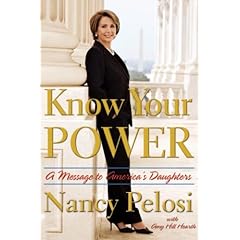
In an online discussion on August 6, Nancy Pelosi discussed her new book, Know Your Power: A Message to America's Daughters, with the listeners of Book World Live. As was written in the Washington Post, the book is about "the women who have inspired her in her personal and professional lives, and about the lessons she wants to pass on to the women in her own family as well as around the country."
One of the participants in the online interview inquired about the role faith has "clear[ly]" played in her life. To this, Pelosi replies:
My faith has always been central to my public service. Growing up in Baltimore, we were raised in a devoutly Catholic family and taught that we had a responsibility to other people and that we must always honor the spark of divinity in each person.I'm not quite sure what it is about Pelosi that makes it "clear" to this individual that faith plays an important role in her life, and I'm a bit confused about this devout Catholicism she seems to have experienced as a child. "Responsibility to other people," especially as a devoted Roman Catholic, includes a responsibility to the unborn, something Pro-Choice Pelosi lacks in her worldview.When I became Speaker, I quoted St. Francis of Assisi, the patron saint of San Francisco: "preach the Bible; sometimes use words." I try to follow that guidance in my work - to remember that we are all God's children and we have a responsibility to each other and to our planet - God's creation.
What are we to make of Pelosi bringing her faith into the public square? Of course, she is suggesting in this quote that she utilizes the words of Assisi to justify an inexplicit use of religious language. But this is, in and of itself, a religious argument for a certain religious language and mission. Simply because she or any other liberal doesn't quote the Bible chapter and verse does not make them secular--secularism truly is a myth. As well, what is most clear is that from her own words she is functioning according to a religious worldview. We may not appreciate its contents and how it works itself out, but she has made it impossible for herself to argue against religious worldviews making themself apparent in the public square.
August 5, 2008
Do They Know it Came from the Outlet Store? The Ethics of Worship and Shopping
I frequent many websites and blogs of womens speakers and one in particular grabbed my attention recently, Begg's sermon bringing it back to my mind. Her focus in the particular post I was reading was advice on how to buy expensive label clothing without the cost. These would be the labels that are sewn in to the clothing and sold in Saks Fifth Avenue and elite boutiques, where a pair of sandals cost as much as my car payment.
At first, I thought it was cool advice...scour Goodwill, look for damaged items in the stores (to repair yourself) and shop the outlets. How exciting it is to look and feel as if you spent a million dollars on yourself! Think again.
What is the testimony of the million-dollar-look? While it may have literally cost you only pennies to own, it can cost you a lot more. The motive in obtaining expensive labels at discount prices is to give the impression that you spent a lot of money and that your outward appearance is worth such an expenditure. Is that really the impression we want to give? Granted, there are casual items that can be purchased, even at Saks, but today's image-driven culture knows exactly how much was on the original price tag.
Sent via BlackBerry by AT&T
July 27, 2008
The "Desperate" Women of Evangelicalism
In an interview posted by Michael Paulson of the Boston Globe (July 25, 2008) in the Articles of Faith blog, Arterburn was asked if the Women of Faith conferences serve as method of evangelism. He replied, "I call it an inspirational conference. We're trying to inspire women that are in big trouble to hang on. We try to inspire them to live the life that God intended them to live."
Does the fact that around 400,000 women each year attend these conferences provide validity to his assertion that these women are in "big trouble?" Or perhaps this is one of the most dominant movements within the evangelical community that vasts amounts of women have access to.
Whatever motivates women to attend, it is clear that within the subculture of women's ministry, women have been convinced that they are in "big trouble." Motivational and self-help books dominate the women's section in Christian bookstores, women's ministries focus in on her need for encouragement and support, and if I were to take a survey, I'm confident that counseling programs would represent the bulk of advanced degrees held by women's ministry leaders.
It might be that women are in constant need of these self-help resources (books, conferences, etc.) because they are actually in need of something deeper will take them through the difficult times. The therapeutic culture of the church functions such that a solid theology is secondary to addressing the day to day issues we face. In other words, knowing God becomes a response to our "big trouble" instead of preparation for loving God and living in general. When relationships are pursued primarily for what one can get out of it, the relationship suffers.
Though well intentioned, I am concerned that Arterburn's comment and this therapeutic culture of women's ministry perpetuates an attitude of helplessness among Christian women. We ought to envision a ministry that develops women in such a way that their spiritual maturity, their relationship with God, is her ultimate resource in times of need. An anemic women's ministry will always need to be therapeutic. A theologically healthy ministry will produce disciples who naturally replicate and find their needs met at the feet of Jesus, and naturally among one another as Titus 2 models. This isn't to devalue counseling as I know how important it is, but the ministry to women in the church must first be Cross-centered. Knowing God makes it possible for women to help themselves.
July 9, 2008
Hearing Her: Evangelical Women's Voices in Bioethics
Part of the problem is internal. Evangelicalism doesn't provide much space for the female theologian as she is almost always relegated exclusively to matters of the home (if she is married).. The debates over roles in the church and family limit the likelihood that a woman would enter into the theological academy, and as a result her voice is silent and she has little influence on other women in church and culture.
Feminists and other women's rights activists have a significant voice in public debate largely due to the fact that the Christian community is viewed as being oppressive of women, something that is not entirely true. But the absence of female voices can feed into that generalization.
Grounded in a theology committed to a historical-grammatical interpretation of Scripture, evangelical women can bring a voice of faith, reason and experience to bioethics issues. The experienced joy of womanhood within the framework of a Christian worldview is an invaluable resource for the church in ministry to women in church and society at large.
June 3, 2008
Worldviews in Conflict: Secular Spirituality’s Heart-hold on Women
Showing the contrast between the historic Christian faith and the secular-friendly spiritualities of today’s world may not go over well with friends and neighbors. In fact, there are many women within the walls of the church who are attracted to the latest wave of talk-show religiosity. These age-old heresies in celebrity attire have a heart-hold on women everywhere, revealing an urgent need for apologetics--a defense of the faith--in women’s ministry.
In the Oprah-endorsed book “A New Earth” by Eckhart Tolle, truth is redefined as you. Forget that Jesus is the way, the truth, and the life, or that there are facts about God, life and reality that we can be certain about. All of this is tossed out for the sake of you. Tolle writes:
The Truth is inseparable from who you are. Yes, you are the Truth…Jesus tried to convey that when he said, “I am the way and the truth and the life.” These words uttered by Jesus are one of the most powerful and direct pointers to the Truth, if understood correctly. If misinterpreted, however, they become a great obstacle. Jesus speaks of the innermost I am, the essence identity of every man and woman, every life-form, in fact. (p. 71)
This section from “The New Earth” is laden with difficulties. If truth cannot be found in words, but is self-contained in the knower (that’s you), then Scripture has no meaning and there has been no self-disclosure from the God of Scripture. This is a direct assault on the authority of Scripture and the Christian worldview, dangerous to anyone who subjects their mind to this way of thinking. There are eternal ramifications. As well, if there is no truth to be found in words, Tolle has no truth to impart on the matter. The self-refuting nature of his argument is glaring.
The authority of Scripture is only one of Tolle’s challenges to orthodox Christianity. It cannot be suggested that every person, “every life-form,” is the way, and the truth and the life, without holding that these are all God. This is a teaching called pantheism and is a common teaching of Eastern religions, as Tolle himself explains in this book. God cannot be identified with the Universe or the created order as God is the creator of all things.
The search for truth is, I believe, the result of the search for meaning and significance. As women gravitate to the spiritual gurus of self-helpianity trying to get a handle on their place in this world, they need to know that Truth exists and is found in the person and work of Jesus. Someone needs to be ready to give an answer, the only way to peace and contentment is through knowing the God of all creation. The meaning of life is found in Christ. WFC