Showing posts with label religion. Show all posts

April 30, 2009

Abortion: The Debate's Transition to the Private Realm

During last night's 100 day press conference, President Obama declared--almost word for word to previous statements--his position on abortion. Even though he isn't a great speaker, he likely is a wordsmith on paper and has framed this language in such a way that it sounds logical, caring, respectful of religion, and dare I say, even centrist.
You know, my view on abortion I think has been very consistent. I think abortion is a moral issue and an ethical issue. I think that those who are pro-choice make a mistake when they — if they suggest — and I don’t want to create straw men here, but I think there are some who suggest that this is simply an issue about women’s freedom and that there’s no other considerations. I think, look, this is an issue that people have to wrestle with, and families and individual women have to wrestle with.
There is some serious strategy going on here. I believe what Obama is trying to do is de-politicize abortion for the sake of the pro-abortion position. By referring to it as a moral issue that "families and women have to wrestle with" he is eliminating the notion of objective morality and linking abortion instead the realm of private values. But if the debate remains tied most dominately to the extreme feminist, reproductive rights movement, abortion remains open to public debate amongst ideological foes, each with the assumption that there is an objectively correct answer. And if that debate continues to rage, Obama can't appear as if he is taking no side. But there is more.
The reason I’m pro-choice is because I don’t think women take that position casually. I think that they struggle with these decisions each and every day, and I think they are in a better position to make these decision ultimately than members of Congress or a President of the United States — in consultation with their families, with their doctors, with their clergy. So that’s been my consistent position.
There is a ton to address in this portion of his statement, but what I want to focus your attention to the "private" relationships he mentions, between a woman and her family, doctor, clergy. His administration's work to mute the public abortion debates leaves it in the realm of these private relationships...and take note that religion is removed from the public realm (no surprise) into the private life of the woman. This is the only place where religion has a voice in the matter.

This statement he makes is clearly driven toward a removal of religious voices from the public square, and the fact that he consistently makes his position known suggests his words need to be closely examined. If the Obama administration succeeds in muting the debate, even if only on the side of the pro-aborts, religious voices will be even further marginalized and secularism will be the default worldview, even among those who identify themselves as Christian. And we see a lot of that occuring already.

December 22, 2008

The Demise of Evangelical Distinctiveness?

I feel like I'm living in a historic time, not simply because our next president is mixed-race or because Illinois political corruption is finally revealed for the rest of the nation to appreciate, but because I think evangelicalism is caving to societal pressure to look like anything other than its former self. My concern is that evangelicalism in the public arena no longer includes a passionate defense for the unborn (because that would simply be too politically divisive). Instead, it seems we are focusing our greatest energies on other issues-- not for the sake of those other issues, but rather to gain some political common ground. Don't get me wrong, I know there are many evangelical individuals and organizations still in the fight for the rights of the unborn. But as some older generations are beginning to fade away, I wonder who will be interested in continuing to support this and related causes. As I watch the news and trends in the church, I wonder if there is a generation of evangelicals even interested in taking up the cause for life. Feminism is succeeding in indoctrinating several generations of women on their platform of equality and corresponding reproductive rights while the church fidgets to understand how to develop a culture of God-fearing women who can love both their families and careers, or at least appreciate that our society simply demands that women be able to work because men have failed to responsibly lead. But I digress. Will Christianity be able to survive this politization of faith? Where it appears that the left is capitulating to evangelicalism, such as by inviting Rick Warren to do the Inauguration, do you think it might really be about blurring the lines and causing confusion? The ability for any party to cross party lines is usually indicative of moderate-ism. Is this what we should expect of our faith-based discourse? The church is being silenced internally and externally on life issues someone needs to speak to; it's never taken up the cause for women in a real practical way that avoids the extremes of secular feminism but still appreciates the giftings of women in whatever sphere she participates in; and the evangelical church is losing its distinctive voice by the manipulation of the smooth-talking left who are out to gain the loyalties of the pragmatic and uninformed. Can the evangelical church survive the next decade?

August 7, 2008

Speaker of the House not Entirely Mum on Faith in the Public Square


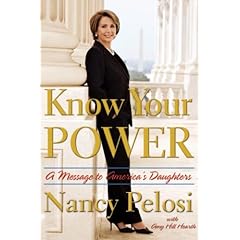
In an online discussion on August 6, Nancy Pelosi discussed her new book, Know Your Power: A Message to America's Daughters, with the listeners of Book World Live. As was written in the Washington Post, the book is about "the women who have inspired her in her personal and professional lives, and about the lessons she wants to pass on to the women in her own family as well as around the country."

One of the participants in the online interview inquired about the role faith has "clear[ly]" played in her life. To this, Pelosi replies:
My faith has always been central to my public service. Growing up in Baltimore, we were raised in a devoutly Catholic family and taught that we had a responsibility to other people and that we must always honor the spark of divinity in each person.

When I became Speaker, I quoted St. Francis of Assisi, the patron saint of San Francisco: "preach the Bible; sometimes use words." I try to follow that guidance in my work - to remember that we are all God's children and we have a responsibility to each other and to our planet - God's creation.

I'm not quite sure what it is about Pelosi that makes it "clear" to this individual that faith plays an important role in her life, and I'm a bit confused about this devout Catholicism she seems to have experienced as a child. "Responsibility to other people," especially as a devoted Roman Catholic, includes a responsibility to the unborn, something Pro-Choice Pelosi lacks in her worldview.

What are we to make of Pelosi bringing her faith into the public square? Of course, she is suggesting in this quote that she utilizes the words of Assisi to justify an inexplicit use of religious language. But this is, in and of itself, a religious argument for a certain religious language and mission. Simply because she or any other liberal doesn't quote the Bible chapter and verse does not make them secular--secularism truly is a myth. As well, what is most clear is that from her own words she is functioning according to a religious worldview. We may not appreciate its contents and how it works itself out, but she has made it impossible for herself to argue against religious worldviews making themself apparent in the public square.

February 24, 2008

Obama's Public Religion

I never cared to read Obama’s Audacity of Hope, but I recommend you do as it is helpful in understanding the nature of his political aspirations.

Negative Campaigning & Partisan Politics
For those of you fearful of being accused of “negative” or unnecessary “partisan politics,” check this out. Obama hopes that the weight of such accusations are stronger than your own convictions. He writes,

Perhaps my greatest bit of good fortune during my own Senate campaign was that no candidate ran a negative TV ad about me. This had to do with the odd circumstances of my Senate race, and not an absence of material with which to work. After all, I had been in the state legislature for seven years, and had cast thousands of sometimes difficult votes.” (chapter 4, page 132)

This “good fortune” is unfortunate, but seems to be continuing.

One of the messages we hear from Obama is that the focus on what divides conservatives and liberals are really small and incidental issues, and that they should be abandoned for the sake of unity. The notion that taking a firm stand on conservative convictions amounts to nothing more than partisan politics is condescending and philosophically fraudulent because it seems that the issues he thinks ought to be abandoned are those that typify conservatism—I don’t see any concessions coming from him.

Obama’s Postmodern View of Truth
A look at his childhood reveals how he has come to understand truth, and that his political views are really an extension of his religious views, thus his religious beliefs are clearly being communicated in the public square. Speaking of his mother, he says that

In her mind, a working knowledge of the world’s great religions was a necessary part of any well-rounded education. (p. 203)

She’s not entirely wrong, but to what end does this knowledge serve in her mind? We should understand the teachings of other religions, but not embrace them all as equally valid.

He continues,

In our household, the Bible, the Koran, and the Bhagavad Gita sat on the shelf alongside books of Greek and Norse and African mythology. On Easter or Christmas day, my mother might drag me to church, just as she dragged me to the Buddhist temple, the Chinese New Year celebration, the Shinto shrine, and the ancient Hawaiian burial sites. But I was made to understand that such religious samplings required no sustained commitment on my part…Religion was an expression of human culture, she would explain, not its wellspring, just one of the many ways…(p. 204)
And yet for all her professed secularism, my mother was in many ways the most spiritually awakened person that I’ve ever known. She had an unswerving instinct for kindness, charity, and love, and spent much of her life acting on that instinct…Without the help of religious texts…she worked mightily to instill in me the values that many Americans learn in Sunday school; honesty empathy, discipline, delayed gratification, and hard work. She raged at poverty and injustice, and scorned those who were indifferent to both. (p. 205)
Christianity is not just about values, nor is it about “personal values,” it is about ultimate truth. This obviously escapes him as he clearly emulates this state of “spiritually awakened” he attributes to his mother. Kindness, honesty, and hard work values that can be seen in the day-to-day life of an atheist. These behaviors should be seen in all believers (fruit), but the presence of these does not make one a Christian.
But it was my mother’s fundamental faith—in the goodness of people and the ultimate value of this brief life we’ve each been given—that channeled those ambitions. (p. 206)

Obama knows that this sort of religiosity is empty as he states that the dilemma his mother faced was passed on to him—that he had “no community or shared traditions in which to ground [his] most deeply held beliefs.” But Obama never really convinces himself—or me—that he has fully embraced orthodox Christianity. I’m not suggesting that he might not be a believer (nor am I suggesting that he is), but he offers several statements that suggest his system of belief outright rejects the historic Christian faith.

Almost by definition, faith and reason operate in different domains and involved different paths to discerning truth. Reason—and science—involves the accumulation of knowledge based on realities that we can all apprehend. Religion, by contrast is based on truths that are not provable through ordinary human understanding—the ‘belief in things not seen.’ When science teachers insist on keeping creationism or intelligent design out of their classrooms, they are not asserting that scientific knowledge is superior to religious insight. They are simply insisting that each path to knowledge involves different rules and that those rules are not interchangeable. (p. 219)
This is almost unfair to Obama because the flaws here are so many and so obvious. His argument suggests that science doesn’t start with presuppositions or pre-understanding. The truth is, science does not operate in a vacuum, outside of the influence of personal bias—and brute facts simply do not exist. Obama’s political philosophy is clearly seen in this statement as he falls into a Rawlsian trap, that moral assertions in the public square can never be grounded in religious reasons because of the pluralistic nature of our society. For religious reasons to have a bearing in the public square is to infringe on the freedom of nonreligious persons according to Rawls. This is where secularism gets some of its philosophical footing, as if it is religiously neutral, as if it is even possible for any idea or philosophy to be religiously neutral. Religious neutrality is a myth and reasons asserted by anyone in the public sphere eventually find their way back to a religion or worldview.

Another statement that impugns Obama on his claim to Christianity is his postmodern hermeneutic that pits certain passages of Scripture against others. It’s reminiscent of a feminist hermeneutic in that he is filtering the biblical text through his experience. Pitting verse against verse, he states,

I am not willing to have the state deny American citizens a civil union…nor am I willing to accept a reading of the Bible that considers an obscure line in Romans to be more defining of Christianity than the Sermon on the Mount. (p. 222)

Its unclear how he determines that the Romans passage is “obscure” or how the Sermon of the Mount is to be understood in isolation of Romans or any other area of Scripture. But it is clear that Obama, despite his great spiritual notoriety, is no theologian.

Finally, Obama’s view of Scripture is best understood in his own words.

When I read the Bible, I do so with the belief that it is not a static text but the Living Word and that I must be continually open to new revelations… (p. 224)

This statement is clearly problematic. While we may refer to Jesus as the Living Word, we must accept the Scriptures as unchanging in meaning and intent, though we as fallible humans may not always understand what read. We cannot confuse our inability to always discern the meaning of the text with God revealing new meanings unrelated to the text. The Bible was written by men in time and space with specific messages, not with ambiguous and every-changing purposes. To be generous, it’s unclear exactly how far Obama wants to take his method of interpreting Scripture, but it is safe to say that he has kept the door open for interpreting Scripture according to experience. His is a faith of values and experience, not of knowledge.

Concluding Remarks
The hype over Obama in the last year has been about nothing—literally. His campaign could be an episode of Seinfeld. He’s gone to great lengths to be not only the candidate of change, but the candidate of charisma….so shallow that it might actually work to win the general election. This is more of an indictment on the American voters than it is on Obama, unfortunately. But realize that he is equally a product of this shallow society. What are the dangers for America if he is to become the most powerful leader in the world? An increase in access to birth control, fewer parental rights, tighter restrictions on religious expression, higher taxes, naïve foreign relations that put America at risk……
August 8, 2007

Secularism’s Dependence on Compartmentalization

It isn’t just that secularism prefers that you believe certain things about pluralism and politics, secularism just doesn’t want your life to have any meaning. I don’t mean that they, secularists, don’t want you to feel as if you have no purpose in life, but that is really the logical outcome of this way of looking at the world. I have a habit of not making mention of some of my thoughts as I formulate my commentary on a variety of subjects, secularism is no exception, so please bear with me on this.

The secular worldview in its embrace of religious pluralism and rejection of absolutes and of religious involvement in the public square is ultimately asking you to live a life that lacks coherence. What the heck does that mean? For secularism to retain it’s stronghold over the religiously wimpy, it must persuade them that religion can function in isolation of other important areas of life and it can’t possibly inform these other areas – because religion shouldn’t inform these areas. For example, when speaking of women’s reproductive rights, Christians with a conservative point of view can’t possibly contribute anything to the discussion because their point of view is in disagreement with the liberal slant. Now obviously, not all religious views are hostile to the pro-choice perspective, but prominent secular humanists would prefer that they not speak up, even to affirm the prochoice political agenda.

One thing I’ve always felt a need to address is the charge that evangelicals politicize issues, essentially by voicing their disagreement. As wonderful as consensus would be, that’s not the world we live in. Disagreements are based generally on differing worldviews, and these disagreements are nothing less than genuine. To avoid public discussion and debate over these disagreements (such as women’s reproductive rights) is like going to war without a weapon. No one in their right mind would do that, neither should we. The charge that we are guilty of merely politicizing a given issue is smoke and mirrors and is self-referentially incoherent. If acting with the same illogical incoherence, the charge could be deflected back. The point is, many matters of disagreement are worth the debate, no prolifer is interested in debating just to make the other person look bad, there is meaning and purpose in the cause. And why does politics have to be a bad word?

But I digress. Secularism depends upon individuals putting their worldview in their back pocket, and they are hoping you are just stupid enough to try it (I say try, cuz it really can’t be done.) The Christian worldview can and will continue to inform our approach on a variety of issues, and it will continue to be a force in the public square. Just how strong of a force is the question.