Showing posts with label women and careers. Show all posts

May 14, 2009

Role Models & Cultural Decay: The Church's Response


In 1984 when Michael Jackson and Madonna were blasting their way through the very large speakers of teenager's boom boxes, girls my age were beginning to bare their shoulders--but only one--to emulate the new Flash Dance style that was sweeping the country. While I was trying to figure out how to wear braided headbands and multi-colored leg warmers, I was also working very hard to hide my interest in Debby Boone and the early Christian contemporary music scene. (FYI, Debby Boone did a lot more than You Light Up My Life that was quite good).

Even though I was actively involved in music as a teen and young adult, it was unpopular to hold up Christian singers as “teen idols” or role models during a time when Rob Lowe, Rick Springfield, and Matt Dillon were all over the cover of Tiger Beat magazine and George Michael was actually considered a heart-throb. Role models in the church were virtually nonexistent for me, and there really weren’t any public role models that I recall, though at the time the Miss America and Miss USA pageants were still competing in one piece suits and campaigning on platforms that were intended to make a difference in our world. These were mostly young women that younger women could be encouraged by and look up to as intelligent and disciplined without all the skin and scandal that epitomizes the pageants today. But perhaps 1984 was the year we saw all of that change, too. That year, now actress Vanessa Williams was crowned Miss America and later dethroned for her morally objectionable photos taken previous to the pageant. Secular feminism has always furthered its cause by promoting its ideology to unsuspecting women who want to be valued and encouraged, and the secular feminists have been happy to oblige this need with little protest from Christian women.

So who are the real role models that stand out today? I come to this question because our culture rightly searches for role models for the next generations, though they look far and wide and in the wrong places, ultimately finding few. In the church, we call these role models mentors. For younger women who find themselves firmly rooted within the Christian community, they need not look very far to locate them. Their mothers, Bible teachers, youth leaders, women’s ministry leaders, and other Christian women--and men--are reaching into their lives with truth, modeling love for God and obedience to the Word. They are encouraging them to attitudes of selflessness and personal responsibility, to love God with their whole heart, soul, and mind. And if they aren’t teaching those things—among other things—they should be. But how well are we doing in women’s ministry, accomplishing this work we have been called to as women mentoring women?

With the blessing of church and family, many women are about to enter into college with hopes for a future in career or ministry or family—or all three. College instructors become integral to their educational pursuits and may have input into their lives in other deep and profound ways. Christian women are participants in the cultural mandate as mothers, business women, writers, teachers, and so forth, and have a great deal to teach younger women about being a Christian in the workplace and how to pursue the many spheres of life from a Christian worldview. And if Christian women do not take up this ministry as a fulfillment of Titus 2, certainly the attention of young women will be drawn to unhealthy role models. How can we make a difference in their lives?

Church women’s ministries are in a unique position to shape the beliefs and ideas of future generations of women, allowing our experience as women as interpreted through the teachings of scripture to impact their lives. For this to happen, we need to consider our ministry methods. Are we so event driven that we wear ourselves down with the administration of ministry that we never actually get to do ministry? Who are we focused on—the women who want to be entertained or the women who need to be nurtured? We need to talk about womanhood and motherhood, discussing the ideas that shape the world (philosophy), the ideas that shape our worldview (theology), and the goals of education and career. We need to make a place for these conversations—in the context of mentoring relationships, in formal study settings, in books, etc. And for women in the workplace, you have a unique opportunity that escapes the church, to mentor the women who cross your path and communicate the message of the Gospel in a spirit of love and compassion. For those in the world who is still searching for role models, they can be found if we are willing.

The glory of God is to be the purpose of any ministry we participate in. It is not to the glory or autonomy of the self that should motivate our desire to be role models or to mentor others. But we should see the task as an urgent matter, because as the decaying culture continues to infect the church, fewer examples of godliness will be available as examples for the generations that follow.

January 23, 2009

Who Will Protect Women from Women's Rights Ideology?

Though grateful for the right to vote and to pursue a career of my choice, I cannot help but to be terribly frightened for the women at the mercy of the movement that claims to be looking out for their well-being. As Obama begins to lift funding restrictions on abortion and embryonic stem cell research, NOW, NARAL, and the Feminist Majority drown me in press releases about the so-called victories for women's rights. Yet, women are more vulnerable now than ever before as the media continues to worship their messiah and killing unborn children is still, somehow, considered a women's health issue. There is a reason the new administration is removing "war on terror" language, because they rightly understand this this is a war of words. Only words can explain to young women about to have their ovaries invaded, that when their egg is fertilized, it is an embryo, the technical term for what is otherwise known as their child. And make no mistake about it, this genetic material--another word for their child--is living. After all, embryonic stem cell research is not pursued with non-living (i.e., "dead") embryos.

Here is another interesting use of words on the contraception marketed as Mirena. With all of its risks, this IUD works like....well, they don't exactly know. See what they say about it:
How does Mirena work?
It is not known exactly how Mirena works. Mirena may work in several ways. It may
thicken your cervical mucus, thin the lining of your uterus, inhibit sperm movement and reduce sperm survival. Mirena may stop release of your egg from your ovary, but this is not the way it works in most cases. Most likely, these actions work together to prevent pregnancy.
This post is not an appeal to the Obama administration or the FDA or to womens' rights groups to practice integrity and responsibility with their use of words. That is a fairy tale dream. This is an appeal to women to practice critical thinking skills, and know when your life is being put at risk for the sake of political ideology.

September 20, 2008

Gospel Today, Southern Baptists, and Theology in the Pew

Reportedly, the SBC's Lifeway Christian Bookstores have removed the current issue of Gospel Today from their sales shelves in more than 100 of their stores. Chris Turner, a spokesman for Lifeway Resources, said the cover was not the reason the magazine was pulled.

The buyers said the statements that were in it took positions that were contrary to what we would say...It wasn't so much that there were women on the cover.

What I find very interesting is that the contents of Gospel Today should have been in question in the past. Prior to this issue, other cover articles have included prosperity teachers Bishop T.D. Jakes (who rejects the doctrine of the Trinity) and Pastor Paula White. Yet the same folks who are up in arms over the current cover article don't seem to have an awareness about other equally important--likely more important--doctrines this magazine highlights, or else we would have heard about their concern before. This ultimately points to the overall ignorance of the market at Lifeway Bookstores, certainly not their theological sophistication, otherwise this would have been off the shelves a long time ago.

On the other hand, there is something to be said about having materials available to the Christian community that provide first-hand knowledge of what other schools of thought are teaching. I've never read Gospel Today and don't expect to even pick up the most recent copy. But sometimes people need to read things for themselves instead of being coached on the beliefs of others.

I am not an advocate of women as pastors or elders, but I don't believe a person's salvation or commitment to Christ is or should be in question when someone holds an opposing view on this particular issue. This is not a matter of heresy and certainly not worth the negative publicity that will result, especially in light of the current cultural discussion of women as leaders. For the SBC, this is an embarrassment. For Gospel Today, it will sell more magazines.


August 29, 2008

Sarah Palin: Hope, Change, and a Role Model to Christian Women


I was hoping for Huckabee, I was expecting Pawlenty or Romney. Pleasantly suprised, I am so excited about McCain's selection of Gov. Sarah Palin for Vice President.

The choice of Gov. Palin as McCain's running mate brings conservative values and government ethics reform--something Senator Obama fails to address of his corrupt home state of Illinois--to the forefront of this election cycle.

Wife to Todd and mother to 5 children, including one with Down's Syndrome who Gov. Palin chose not to abort, is an inspiration to women everywhere, but particularly to women in the evangelical community who aspire to leadership but have few role models. In addition to her work throughout this election, I encourage Palin to reach out to young women who want to know how to be a Christian and how to be an effective leader without compromising ethics and integrity. Gov. Palin has broken through the glass ceiling in the sense of being called to the role of Vice President, but she makes it possible for women in the evangelical community to recognize that one need not be a secular feminist to aspire to such possibilities.

August 27, 2008

Women's Leadership Conference--Oct 18, 2008

If you're in the Chicago area, you want to plan to attend the 1 day conference for women's leaders--in church, culture, or the marketplace. It's a conference for all ages and designed to accommodate your busy schedule. Find the details here.

Who are the conference speakers?
Session 1
From Dial Ups to Smart Phones: Women's Ministry Then & Now
Felecia Thompson, Trinity Christian College, Palos Hts IL

Session 2
Kingdom Writing: How Your Words Serve Heavenly Purposes
Caryn Rivadeneira, Christianity Today: Gifted for Leadership

Session 3
The Caris Approach: The Third Voice
Angie Weszley, Caris Pregnancy Clinics

To register or to obtain more info, email wm@convergemidamerica.org

August 7, 2008

Speaker of the House not Entirely Mum on Faith in the Public Square


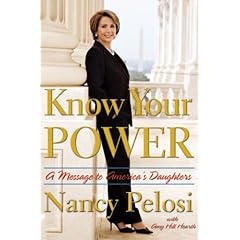
In an online discussion on August 6, Nancy Pelosi discussed her new book, Know Your Power: A Message to America's Daughters, with the listeners of Book World Live. As was written in the Washington Post, the book is about "the women who have inspired her in her personal and professional lives, and about the lessons she wants to pass on to the women in her own family as well as around the country."

One of the participants in the online interview inquired about the role faith has "clear[ly]" played in her life. To this, Pelosi replies:
My faith has always been central to my public service. Growing up in Baltimore, we were raised in a devoutly Catholic family and taught that we had a responsibility to other people and that we must always honor the spark of divinity in each person.

When I became Speaker, I quoted St. Francis of Assisi, the patron saint of San Francisco: "preach the Bible; sometimes use words." I try to follow that guidance in my work - to remember that we are all God's children and we have a responsibility to each other and to our planet - God's creation.

I'm not quite sure what it is about Pelosi that makes it "clear" to this individual that faith plays an important role in her life, and I'm a bit confused about this devout Catholicism she seems to have experienced as a child. "Responsibility to other people," especially as a devoted Roman Catholic, includes a responsibility to the unborn, something Pro-Choice Pelosi lacks in her worldview.

What are we to make of Pelosi bringing her faith into the public square? Of course, she is suggesting in this quote that she utilizes the words of Assisi to justify an inexplicit use of religious language. But this is, in and of itself, a religious argument for a certain religious language and mission. Simply because she or any other liberal doesn't quote the Bible chapter and verse does not make them secular--secularism truly is a myth. As well, what is most clear is that from her own words she is functioning according to a religious worldview. We may not appreciate its contents and how it works itself out, but she has made it impossible for herself to argue against religious worldviews making themself apparent in the public square.

July 9, 2008

Hearing Her: Evangelical Women's Voices in Bioethics

When we think about women's voices speaking to any particular issue in society, it's easy to assume those voices belong to secular feminism and not evangelical theology. This isn't to suggest that there are no evangelical women theologians involved in important areas like bioethics, but the numbers are low and have little bearing on what is referred to as "women' issues." This is a topic I will be speaking about next week at CBHD's summer bioethics conference.

Part of the problem is internal. Evangelicalism doesn't provide much space for the female theologian as she is almost always relegated exclusively to matters of the home (if she is married).. The debates over roles in the church and family limit the likelihood that a woman would enter into the theological academy, and as a result her voice is silent and she has little influence on other women in church and culture.

Feminists and other women's rights activists have a significant voice in public debate largely due to the fact that the Christian community is viewed as being oppressive of women, something that is not entirely true. But the absence of female voices can feed into that generalization.

Grounded in a theology committed to a historical-grammatical interpretation of Scripture, evangelical women can bring a voice of faith, reason and experience to bioethics issues. The experienced joy of womanhood within the framework of a Christian worldview is an invaluable resource for the church in ministry to women in church and society at large.

March 12, 2008

Women's Ministry: Raising the Bar

I know I've written on this in various ways in the past, but this time of the year necessitates talking about it again. Believe it or not, it's the middle of March and a lot of young people are preparing to leave high school and enter into university campus life. For young Christian men pursuing higher education to serve the church, their options are many...more so than for young women. As the young men enter into college and seminary, they have the blessing to pursue various pastoral positions ranging from youth pastor to associate and sr. pastor within the evangelical context. It's also clear that many of these men will find themselves quite lucky (I'm a Calvinist, that's just a figure of speech) to become college and seminary professors-with greater ease than women. I'm glad that these young men are pursuing these and other avenues to serve and I'm not about to argue for a liberal perspective on gender roles. But I do think the church needs, at this time in history, more women on staff and in full time ministry.

Young women today are extremely interested in the life of the mind and the study of theology. This isn't to suggest that she never has been before. But today's young women are inspired and have a serious passion for engaging culture and sharing the gospel, being a part of the transformation of hearts and minds. The culture of women's ministry in evangelical circles has largely been focused on women's survival....getting enough encouragement to get by. Because of the complexities of today's world, in the areas of worldview and activism, its becoming more urgent for seminary-level trained women to enter the evangelical community vocationally. The needs of women in church and culture are well beyond the scope of what traditional event-driven women's ministry can address.

I've read a lot about how the church has or is becoming feminized, that worship music and styles of preaching have led to the disenchantment of men to such an extent that he isn't interested in going to church-it's for girls. And yet the expectations of girls-women-is to remain as they are, and not pursue more manly things. I realize the big metaphorical broom I have here, but its time to stop sweeping this under the rug and place it where all can see. Our Christian culture expects to train young people to be able to cope with whatever society throws at them, yet young Christian women are often held back from higher theological education. We need to not only encourage them to pursue philosophy and theology in the seminary context, but the church needs to recognize their role in God's Kingdom and how they can and should serve. Let's stop business as usual in women's ministry and raise the bar for its leadership. How can we do that?

1. Expand your view of women's ministry to see the opportunities for engaging the women not in church. How can you use elements of today's culture to reach women? Oprah's book club is a key example.

2. Excite women about the life of the mind. Provide a context for women to excel theologically in their studies; the lowest common denominator shouldn't be the primary focus.

3. Reconsider the solution to feminization. If this is a problem in your church, a solution might actually reside in the ministries to women. Develop those ministries beyond the clichés, raising up leaders who see the church as more than a place for group therapy and personal survival.

4. Develop a vision for women in ministry that encourages young women to seminary and invites women as an appropriate member of the pastoral staff. She has an important place in ministry to women.

February 8, 2008

"Abstinence Sucks"


Shocking, isn't it? Well that's the message being touted at the upcoming National Young Women's Leadership Conference: What's At Stake in 2008 sponsored by the Feminist Majority Foundation. Are we really going to sit back and watch our young women be influenced by lifeless feminism, or are we going to take a stand for the important place of young women in our culture and bring them a message that considers their best interests and protects them and their children, encouraging them professionally and their own involvement socially?

FeministCampus.org states that the conference is to take place in Washington D.C. on March 8-9:
Topics will include Get Out Her Vote (GOHV), Birth Control Pricing, Crisis Pregnancy Centers (Fake Clinics), Global Reproductive Rights, and more!
Again, as I noted last year, this event is driven predominately by bioethics..and completely in opposition to our prolife views. 'Fake clinics?' Yes, it's a political event - I see they're wasting no time so that they can reach young women before the election in November with their message of reproduction.

But shame on us for abandoning these young women to feminism. What the heck is the evangelical Christian community doing to make a place for young women? I'm not talking about making compromises in doctrine, I am talking about entering the 21st century and seeing the leadership potential in both genders and encouraging young women in their quest to fulfill the creation mandate. And what are we doing to teach our young women about 'reproductive responsibility' or the creation mandate? If we keep these discussions among the middle age crowd, we'll lose the battle entirely. Our young women are begging for a movement that recognizes and appreciates their contributions to society and to the church. The time to act is now, let's stop talking about what women can't do in the church and talk about how God wants to use women in church and culture. Then we might not have to worry about "abstinence sucks" campaigns.

January 25, 2008

Developing Young Women for Work

We all (hopefully) are familiar with the cultural mandate (creation mandate) as it is termed by theologians. The command to have dominion over the earth...to fill it, subdue it, etc....this is an important place to develop ministry to young women.

In this first command, the inhabitants of the earth were called to labor in the garden. Genesis 2:15 states The Lord God took the man and put him in the garden of Eden to work it and keep it (ESV). Take note that this command is pre-Fall. Labor--work--has always been a component of our existence. Work is good and is a reflection of God's work. As Creator of everything, He labored to create. As image bearers, we reflect this through the business of cultivating the earth.

Today, young women have many opportunities before them--though we ought not forget the challenges women face in the workforce. But as a matter of spiritual care--because everything, including our work, belongs to God--we can play a part in their vocational journey by providing various mechanisms that serve to counsel her in career decisions. Here are some ways to bring this to a reality in your church's women's ministry:

1. Who on your women's ministry team is already geared toward ministry to young women? She will likely be a key player in this new component to women's ministry.

2. Discussions with men and women in various professions--develop a monthly meeting that will feature a Christian speaker (does not have to be a woman) who represents a select focation. Publicize the talk to the church and in the community. Your community may be pleasantly surprised that your church cares anything at all about career development!

3. Make it known that someone is available to guide and discuss vocation/career decisions, and that doing so is simply a piece of our work as believers.

4. Teach a solid Christian worldview study regularly, one that emphasizes clearly that a Christian vocation need not necessarily be vocational ministry.

5. After your young women begin to make their decisions, you need to nurture them so that they understand that work is labor for the Lord. Connect them with likeminded, mature believers and/or small groups if you know of any.

6. There may be other women in your congregation who are older and might be struggling with re-entry into the work force. Talk with them about their gifts and talents and how those might fit well with particular job or career choices.

7. For all of your women, infest in their development, preparing them to do the same for the young women she encounters in her future.

Further reading on this topic:
Heaven is a Place on Earth by Dr. Michael Wittmer
Total Truth by Dr. Nancy Pearcey
Are Women Human? by Dorothy Sayers
Creed or Chaos? by Dorothy Sayers